The New Labyrinth on the Keesburg at Würzburg (Germany)

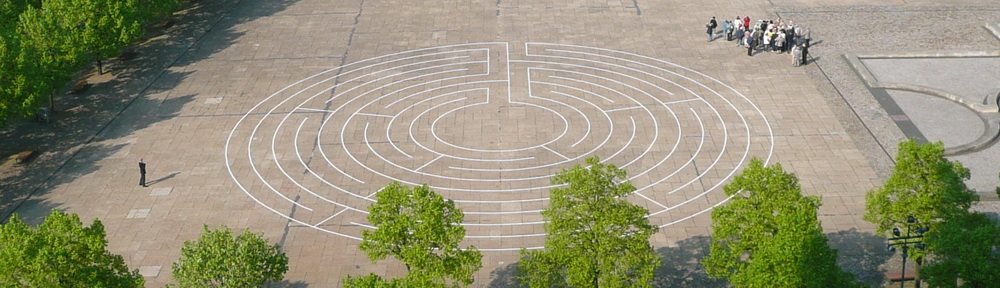
The new labyrinth has now an own front door in the fence around the monastery gardens near the Saint Alfons church. It is situated along the Mittlerer Neubergweg, which is connected with the Mathias-Ehrenfriedstraße. Everybody is invited to visit the labyrinth. It is opened from dask to dawn.

On the 18th of September, 2011 was the inauguration.
Here some impressions:

Picture 1

Picture 1

Picture 2

Picture 2

Picture 3

Picture 3

Picture 4

Picture 4

Picture 5

Picture 5

Picture 6

Picture 6

In the meantime, the local newspaper Main-Post has reported about the labyrinth and there was also a short contribution on the citizen radio last Sunday.
The radio broadcast of the editorial staff of the diocese Würzburg from the 23rd of October, 2011 in the series Cappuccino on radio Charivari Würzburg (translated from German):

Labyrinth at Würzburg

At first sight it looks a little bit bewildering: The form of a winding labyrinth. Who stands before it, tries to recognise the right way. But this is not so easy at all!
The labyrinth – a very expressive symbol which is already known for over 3000 years. Originally emerged probably around the Mediterranean.
During the last years there is a sort of „labyrinth Renaissance” – in towns like Zurich, for example.
Petra Langer has got to know from a new labyrinth in the Würzburg district Keesburg.
Curiously she moved off

I accompanied her.

Petra Langer in front of the labyrinth

Petra Langer in front of the labyrinth

Here the podcast of the broadcasting from October 23, 2011 (in German)

Related Links

The Heart of the Chartres Labyrinth is the Classical Labyrinth

The Chartres labyrinth is closer related to the classical labyrinth (the oldest known type of labyrinth, sometimes called Cretan labyrinth) than we thought up to now, but probably have always anticipated. I realized that when I tried to find some variations for the Chartres type.
A possible approach is for example: How can I make from the 11-circuit Chartres labyrinth one with 7 circuits? But one which comes close to the original or owns its typical qualities. And for me this is manifested in the path sequence: in the order in which the paths are walked on the way to the centre.
I had already seen several 7-circuit Medieval labyrinths, but a nearer look always disturbed me. Now I know that it was the disharmonious path sequence. Since there are many (theoretical) possibilities to reach the goal in 7 circuits.

How could I get a harmonious variation? By leaving out the two outermost and the two innermost rings. Here the drawing:

The entire Chartres labyrinth

The entire Chartres labyrinth

And I will get this 7-circuit Chartres labyrinth:

The 7-circuit Chartres labyrinth

The 7-circuit Chartres labyrinth

Again the high quality of the Chartres type appears, when I omit the barriers in the divided rings: I get a fully operative classical labyrinth. Here the drawing:

The round 7-circuit Classical labyrinth

The round 7-circuit Classical labyrinth

Though it is a “developed” classical labyrinth, because it has a big centre and is perfectly circular. But it has the four turning points and the typical path sequence of the classical labyrinth: 3 – 2 – 1 – 4- 7 – 6 – 5 – centre. The typical seed pattern for this type is slightly shifted, but recognizable.
And here the classical labyrinth with the small centre:

The Classical labyrinth

The Classical labyrinth

The classical labyrinth is the nucleus of the Chartres labyrinth. The development naturally did not go ahead so fast and directly. This took centuries. Intersteps were the Roman labyrinths with the division in sectors and the Otfrid labyrinth with the increase of the number of the circuits in a circular labyrinth. For me also the Knidos labyrinth because it added the bigger middle. The type of the Chartres labyrinth was developed about 300 years before the construction of the real labyrinth about the year 1200 in the cathedral of Chartres. The introduction of the “barriers” is hereby a new element to enable more U-turns. Thus the Chartres labyrinth has 28 turning points compared to the 4 in the classical labyrinth. Or differently expressed: The Chartres labyrinth contains 7 classical labyrinths, the 7-circuit Chartres all the same 4.

This development process can be pursued in old manuscripts from this time. This has in the end produced the extraordinarily perfect Chartres labyrinth. The centre with the 6 petals and the 113 lunations are (at least for me) not the essential elements. These are the harmonious shaping and the path sequence.

Related posts

How to make a 5-circuit Classical Labyrinth from a 5-circuit Chartres Labyrinth

The Chartres labyrinth has many qualities. It allows several variations, among others through the reduction of the number of circuits. So I can derive a 5-circuit labyrinth from the 11-circuit original. By leaving out the first 6 circuits (if I count from the outside inwards). See the following drawing:

The entire labyrinth with the 5 innermost circuits

The entire labyrinth with the 5 innermost circuits

By the way, I can also cut out the 6 inner circuits and take only the 5 outermost ones. This works also. See the following drawing:

The entire labyrinth with the 5 outermost circuits

The entire labyrinth with the 5 outermost circuits

Here the 5-circuit Chartres labyrinth as a whole. Sometimes it is called Inner Chartres, but as we have seen we could name it also Outer Chartres:

The 5-circuit Chartres labyrinth

The 5-circuit Chartres labyrinth

Let us look a little more exactly to the path sequence: At first one comes quite near to the middle, namely on circuit 5. Then I go outwards in turn: 4 – 3 – 2 – 1, even if that leads me to different sectors. In some Roman labyrinths this happens in every sector. Finally I reach the centre directly from the outermost circuit. This is a shortened reproduction of the path sequence of the 11-circuit original, however, contains their whole dramaturgy.

There are only a few concrete examples of this type up to now, as for example the one in Nieuwegein in the Netherlands which I could visit this year.

Can I now produce from this Chartres Labyrinth a classical labyrinth with the circuits not interrupted and the four typical turning points by leaving out the barriers in the vertical and horizontal axes? It is possible. Here the result:

The round 5-circuit classical labyrinth

The round 5-circuit classical labyrinth

The path sequence is identical with the one in the preceding Chartres labyrinth: 5 – 4 – 3 – 2 – 1 – centre. We have got a round classical labyrinth with a large middle and a central and common axis for the last piece of the path and the centre. But the four turning points do not lie in a square as we know it from  the classical labyrinth with the small middle. To change this we determine the seed pattern and draw a labyrinth with a small middle. Here the result:

The 5-circuit classical labyrinth with the seed pattern

The 5-circuit classical labyrinth with the seed pattern

We see the habitual four points with the central cross. But in the middle we have a line more. The vertical axis is so to speak divided in two lines. So we get the same path sequence as in the Chartres labyrinth.

There are still other path sequences known for the 5-circuit classical labyrinth, as for example the one in Peter’s rockery labyrinth.

Can one now generate from the 5-circuit classical labyrinth with the small middle one with a bigger middle which can be called then Knidos labyrinth? It is possible. Here the drawing:

The 5-circuit Knidos labyrinth

The 5-circuit Knidos labyrinth

Dolen in dit doolhof: The (Labyrinthine) “Tuin van Bezinning” at Warnsveld (NL)

The Dutch Maze and Labyrinth Symposium 2011 finished officially on June 3. Outside the provided programme we could find this extraordinary labyrinthine art work.

Tuin van Bezinning

Tuin van Bezinning

In the park of the police academy in the Huis ‘t Velde at Warnsveld lies the “Tuin van Bezinning” (garden of reflection) called national monument by and for the police in the Netherlands. It is a place where people can commemorate and pay honor to those police officers who have died since January 1, 1946 in the performance of her duty, as a result of violence or an accident. The garden is designed as a place for rest, contemplation and reflection on the fundamental values of the police profession. The garden also serves an important function in the formation and development of police officers.
The design, by the firm of landscape architects Poelmans Reesink, is a labyrinth of raised grass and shell paths. The areas of grass are in the shape of acanthus leaves. At the beginning of the 18th century, Daniel Marot, who contributed to the present architecture of Huis ‘t Velde, also applied the acanthus leaf in his architectural details. The names of the deceased police officers are inscribed along the edges of the leaf shapes. In a digital memorial book till now 140 names are listed and the place of every inscription is marked in a site plan.
A water basin at central place is fed from 12 spouts and the water is conducted to the nearby flowing Berkel.
The official opening was in March 2006. Every year on the 2nd  Thursday in June a commemoration ceremony takes place.

Picture 1

Picture 1

Picture 2

Picture 2

Picture 3

Picture 3

Picture 4

Picture 4

Picture 5

Picture 5

Picture 6

Picture 6

Picture 7

Picture 7

Picture 8

Picture 8

Picture 9

Picture 9

The garden is no labyrinth in the strict sense, but the alignment makes it a labyrinth, even more than the already visited “Energy”. Since there is an unequivocal way to the centre. Even if it has several entrances and exits and even bifurcations and dead ends like a maze, nevertheless, it leads in quite a subtle way to the middle. Though the centre is quite a narrow place beside the water basin, it is the highest spot of the whole installation. And if one exactly looks at the steel tins limiting the path and follows her course, one finds unambiguously into the middle. One sees the dead ends in advance and can avoid them while walking to the centre. The steps have a meaning by itself, but are not part of the unequivocal way.

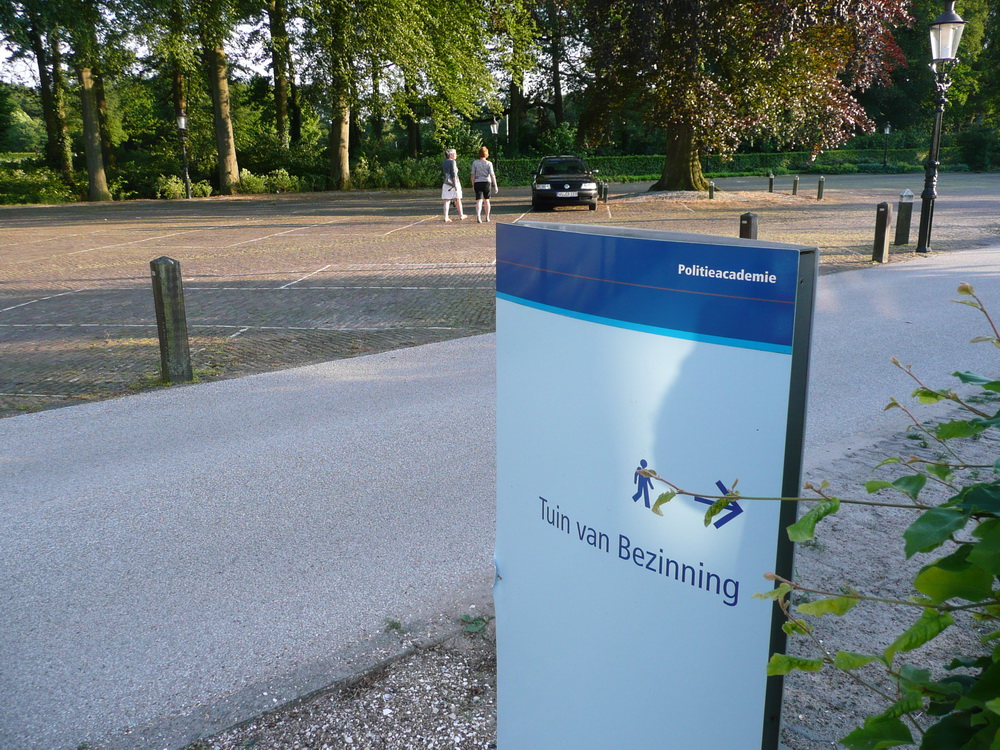
The garden is open daily from dawn to dusk. A big parking lot exists.
Here the interactive map of Google Earth, above all for those who want to visit the memorial. It is not easy to find and also most locals do not know it:

Related links (in Dutch)